Ads (Ujoin)

2011年5月20日星期五

Prototype of Original Apple TV ('iTV') Hits eBay


An eBay listing for a prototype of the original Apple TV has appeared on the auction site, giving interested users nearly a month to snap up the collectible item with a "Buy It Now" price of $350.


Photos accompanying the listing show an Apple Development Team inventory barcode on the side along with a sticker marking the unit as a "DVT" prototype and listing the manufacturers of a number of components used inside the device. The device also has a plain Apple logo on its top as had been used when the device was initially previewed as the "iTV". Apple added a "tv" next to the logo for the shipping version of the product, which was renamed "Apple TV".


The photos also show the device booted up and displaying the stock photo screensaver, although it is not connected to the Internet and the item's description indicates that it has not been fully tested for functionality. Interestingly, despite the hardware bearing a resemblance to the pre-2007 iTV, the device does appear to have received software updates since that time, as it is running the more modern user interface introduced as Apple TV 3.0 in late 2009.

Prototypes of Apple hardware do appear from time to time on eBay, with some notable examples including third-generation iPod touches, a Mac Pro, and an early MacBook Air. Many of these listings have been quickly pulled, presumably at the request of Apple once they come to its attention.

(Quoted from MacRumors)

2011年5月12日星期四

Apple again sued over iPhone location data, personal information

Another lawsuit against Apple has emerged, alleging that the company commits fraud, abuse and unfair trade practices because it transmits the iPhone's Unique Device ID and location information to third-party advertisers.

Filed in the United States District Court for the District of Puerto Rico by Lymaris M. Rivera Diaz, the new lawsuit accuses Apple of "intentionally intercepting personally identifying information," The Loop reports. The Weather Channel, Pandora Media and as many as 10 unnamed companies, provisioned as Does 1-10, are listed in the complaint.

According to the report, Apple faces six different charges, including fraud, abuse and unfair trade practices, for its alleged practice of capturing an iPhone's UDID and location data and sending the information to advertisers.

The filing comes on the heels of another lawsuit also targeting Apple and Pandora Media Group. Filed in New York, the lawsuit took issue with Apple's lack of a method to "delete or restrict access" to a device's UDID. The suit also alleges that the company collects data from users without their consent. As with a similar complaint from December 2010, the lawsuit appears to be based off of an article from The Wall Street Journal that highlighted the use of anonymous user tracking in mobile apps.

In April, a class-action suit was filed against Apple over an alleged "location tracking" file in the iPhone publicized by security researchers last month.

Apple has since revealed that the database in question is actually a crowd-sourced database of Wi-Fi hotspots and cell towers. CEO Steve Jobs said in an interview that people "jumped to the wrong conclusions" about the file.

The company admitted that a bug in iOS preserved the data for longer than was necessary. Last week, Apple released iOS 4.3.3 to address the issue.

While testifying at a Senate Judiciary subcommittee hearing earlier this week, Apple Vice President of Software Technology Guy L. "Bud" Tribble reaffirmed the company's commitment to privacy. "Apple is strongly committed to giving our customers clear and transparent notice, choice and control over their information, and we believe our products do so in a simple and elegant way," he said.

For several years now, Apple has been the world's most-sued tech company. As such, the company has brought on several prominent lawyers as outside counsel to protect itself.

(Quoted from: AppleInsider)

Apple pulls iAds from iOS software geared toward children

Citing a lack of interest from advertisers, Apple has decided it will not display advertisements from its iAd network in applications for the iPhone and iPad that are meant for children, according to one developer.

Mike Zornek, creator of the Pokemon-game-themed "Dex" application for iPhone, sent an e-mail to Apple after his advertising fill rate dropped to 0 percent. As first reported by MacStories, this week he received a reply from a member of Apple iAd Network Support.

"We periodically review the apps in the iAd Network to ensure that all apps receiving ads are aligned with the needs of our advertisers," the employee explained. "Currently, our advertisers prefer that their advertising not appear in applications that are targeted for users that are young children, since their products are not targeted at that audience."

Zornek expressed frustration over Apple's handling of the situation on his personal blog, because the iPhone maker didn't reach out to him to explain the situation beforehand, or post a notification on the iAd developer page. He warned that other developers should "be careful putting all your eggs in one basket."

"Apple should target their ads better," he wrote. "I would have loved to have seen some ads that were better suited to kids in Dex. It's a shame they don't have the inventory to do so. However the manner in which they've made this policy change just stinks."

Because of Apple's change, Zornek was forced to switch to the AdMob network which is owned by Apple's rival, Google. He explained that iAd's average "fill rate," or percentage of advertisements sent to the Dex application after a request was made for one, was 16.5 percent. AdMob's fill rate is reportedly much higher, but the advertisements carry less value than Apple's network.


iAd


The iAd network launched in 2010, and key advertisers for the network included Nissan and Unilever, but products for children were not a significant presence. iAds are rich, interactive advertisements that allow users to learn more about a product from within an App Store application, rather than launching a browser and exiting the software.

Though iAds got off to a strong start, some advertisers, such as shoemaker Adidas, were said to be frustrated with Apple and its tight control over the advertising network.

In February, one report indicated that fill rates had dropped significantly for developers utilizing the iAd network. Soon after, Apple cut the entry price for advertisers in half, to $500,000, in an effort to reverse the downward trend of fill rates.

(Quoted from AppleInsider)

50% of iPad Magazine Subscribers Allow Apple to Pass Info to Publishers


Last week, Forbes writer Jeff Bercovici asked what was it that changed that prompted Hearst and Conde Nast to suddenly agree to Apple's terms for iPad magazine subscriptions. The answer turned out to be surprisingly simple. Publishers had previously argued that the lack of subscriber information from iPad subscriptions was even a bigger hurdle than the 30% revenue share. Instead of automatically sharing the data, Apple asks individual subscribers to opt in. As it turns out, up to 50% of users agree.
Initially, publishers were worried, reasonably enough, that users would overwhelmingly say no. But they don't. In fact, about 50 percent opt in.
Apple's Eddy Cue confirmed the figure according to Bercovici. The author credits the trust in the App Store as the reason for the high opt-in rate.

(Quoted from MacRumors)

2011年5月11日星期三

Google launches cloud music, previews next Android, promises OS updates for 18 mos.

Google launched the invite-only beta of its new cloud music streaming service Tuesday, along with Android movie rentals, and Honeycomb 3.1 for tablets. It also previewed Ice Cream Sandwich, the next major Android release, and promised that devices will receive future Android updates for 18 months after they launch, through a new agreement with carriers and device makers.

Music Beta by Google, Android movie rentals

As was previously announced, Google on Tuesday launched its new Music service, a streaming product that will remain free while in beta. Initially, the service is only available to those who are given an invite.

The license-free cloud product allows users to upload their library of music to Google's servers, and stream those tracks to Android devices and computers, on both Windows and Mac. The Music Beta software allows users to upload all of the music within their iTunes library and access it on the go.

The search giant unveiled the new product as part of its I/O 2011 conference on Tuesday. It boasted that the music service, when synced to the cloud, means users will never have to sync with a cable again.

Music Beta by Google also lets users "pin" their music for offline use, allowing content to be accessed when a data connection may not be available. Music Beta can be used on Android devices running Froyo or Gingerbread.


Google 1
Music Beta by Google. Google I/O 2011 photos via Gizmodo.


Google also unveiled movie rentals for Android devices, with thousands of movies available to rent for $1.99 A new movies application for Android tablets like the Motorola Xoom allows users to watch movies on the go as well.

Like with music, users can "pin" their movie and download it, even if it's rented and streaming, for playback when a data connection may not be available, such as on a plane ride.

Movies are now available on the Android market, and the official Movies application is available as part of today's Honeycomb 3.1 release, while smartphone users with Android 2.2 will receive the application in the next few weeks.

Google 2
Android movies. Google I/O 2011 photos via Gizmodo.


Android Honeycomb 3.1, coming to Google TV

Google also announced that an update for Honeycomb, its tablet-centric mobile operating system, is available today for Verizon customers. Those who own a Motorola Xoom will be able to update to Android 3.1.

The new update adds the ability to make Android devices act as USB hosts. In one example, they showed an Xbox 360 wired controller being used with an Android tablet via USB.

With the update, users can also stretch widgets horizontally or vertically to make them fit their needs.

Android 3.1 will also come to Google TV this summer, and bring the Android Market with applications. Google also revealed that there are now more than 200,000 applications available on the Android Market.

Ice Cream Sandwich, streamlined updates, accessory support

Google's philosophy with the next major release of Android, dubbed Ice Cream Sandwich, will be "one OS everywhere," across a range of devices. That would mean that Android phones and tablets would be running the same operating system, unlike the current landscape where Honeycomb is restricted only to tablets.

Google said it would have an "advanced app framework" in the next release of Android, allowing developers to scale their software to different platforms. They also boasted that their mobile operating system will "all be open source."

Ice Cream Sandwich is also said to include a new user interface, new widgets, and new applications. It said the next user interface would be "state of the art."

In one demonstration, Google showed off 3D headtracking on a Motorola Xoom using the hardware's forward facing camera.

Google 3
Android Ice Cream Sandwich. Google I/O 2011 photos via Gizmodo.


Google also vowed to streamline the updating process for Android devices. Carriers and device makers have agreed to provide new updates for 18 months after devices are launched, provided the hardware can support the newer versions of Android.

The company also showed off a new standard called Android Open Accessory. Using this, external can be connected to Android handsets and be supported by third-party software.

The search giant provided a demonstration of Android Open Accessory by connecting an Android phone to a stationary bike. It also demonstrated home automation integration called Android @ Home, with Android-compatible lightbulbs from Lighting Science set to go on sale by the end of the year.

(Quoted from AppleInsider)

Previous-gen Apple iPad, iPhone 3GS often outsell new Android devices

Older Apple iOS products sold at a discounted price, like the iPhone 3GS and first-generation iPad, are often more popular than newer devices running the Google Android operating system, a new report claims.

Checks with U.S. retail sales channels conducted by Canaccord Genuity technology analyst Michael Walkley found that the iPhone 4 is "by far" the top selling device at both carriers AT&T and Verizon. But Apple's older devices have also found great success.

"Interestingly, our April checks indicated continued strong demand for the iPhone 3GS at AT&T and iPad 1 at Verizon, as these older generation products with reduced prices often outsold new Android products," Walkley wrote in a note to investors on Monday. "We believe this highlights Apple's significant competitive advantage, and these older products help Apple offer a tiered pricing strategy at key channels."

Checks with Verizon stores found that the 16GB and 32GB versions of the first-generation iPad sold out in less than two weeks after the iPad 2 debuted. And at AT&T stores, the $49 iPhone 3GS outsold newer phones like the HTC Inspire and Motorola Atrix.

Checks with stores found that new Android smartphones were largely gaining share from Windows 7 smartphones, but not the iPhone. Walkley also expects the iPhone to remain the top selling handset at Verizon throughout 2011 as upgrades continue, partially because the carrier is not allowing subsidies to customers that are still under a two-year contract.

Walkley also found that the iPad is by far the best selling tablet, while competing products like Research in Motion's PlayBook or the Motorola Xoom have had "modest sales."


Canaccord


"Longer term, we believe Apple's ramping iOS ecosystem will lead to a stronger replacement sales cycle, and this should help drive strong longer term earnings growth," he said.

Starting with the launch of the iPhone 3GS, Apple began selling the previous year's smartphone model in the U.S. for $99 with a two-year contract. This January, the price of an on-contract low-end iPhone dropped even further, to $49.

Collectively, smartphones running Google Android have surpassed the iPhone in terms of units being sold, due to the multitude of Android-powered devices from numerous manufacturers. No individual smartphone model has been able to compete with the iPhone in terms of total unit sales, however, helping to push Apple to record sales of 18.65 million iPhones last quarter.

Apple also heavily discounted the first-generation iPad after the iPad 2 was announced, with discounts starting at $100 and increasing even more over time. Similar deals were also offered by AT&T, which sold the 3G-capable version of the first-generation device, and Verizon, which sold the Wi-Fi-only model bundled with a MiFi 3G hotspot.

(Quoted from unwire.hk)

2011年5月9日星期一

iOS 4.3.3 Jailbreak 完變得異常耗電? 用新版 JB 吧


有否發 iOS 4.3.3 JB 後比之前更加耗電?,有用家指 Dev-Team 剛推出了新版本的 RedSn0w 及 PwnageTool 已修正此問題,如果你也有該問題的話,重新使用新版本的 RedSn0w 0.96rc16 再 JB 一次吧 ! 以下有連結及教學

redsn0w 0.9.6rc16:
PwnageTool Official BitTorrent Release

iOS 4.3.3 簡單教學
http://unwire.hk/2011/05/06/ios-4-3-3-jailbreak/apple/

來源 :
http://www.iphonehacks.com

(Quoted from unwire.hk)

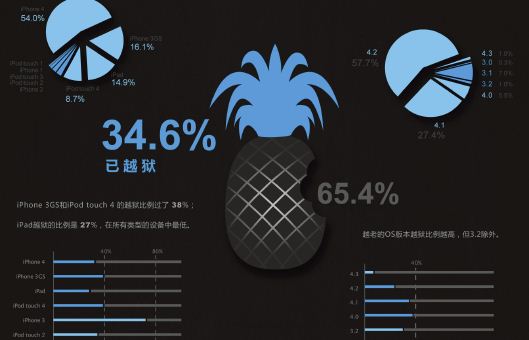
全中國超過 1/3 iOS 已被 Jailbreak


中國一間數據統計公司-友盟公布了國內 iOS 的調查數據,結果顯示國內有 34.6 % 用戶已經 Jailbreak 了 iOS 裝置,iPad Jailbreak 的比例 27% 是眾裝置中最低的。數據又顯示在 Apple iOS 裝置中,有 54% 人在用 iPhone4、16.1% 使用 iPhone 3Gs、iPad 及 iPT 4 則只有 14.9% 及 8.7% 而已。數據亦顯示只有 1.0% 用戶升級到 4.3,有 57.7% 還在用 4.2 ,看來國內用戶們不是太願意緊貼升級,詳細的數據可以他們網站下載瀏覽。

友盟 iOS 報告 2011.04
http://www.umeng.com/report